Try this chapter on paper
Use the original practice PDF after studying. Answers and marking guidance are included. No sign-in needed.
Class 8 Science sample paper: Exploring ForcesStart with an everyday object. Ask what is pushing or pulling it, in which direction, and what changes. Use the videos and short activities below to test your explanation.
1. What can a force do?
Watch: Free-body diagrams and resultant forces
Cognito
Video not loading? Watch on YouTube (opens in a new tab)
Understand it
A force is a push or pull arising from an interaction. It can change speed, direction or shape. A hand squeezing a sponge can change its shape; a sideways push on a moving ball can change its direction. Name both the object receiving the force and what exerts it.
A force can act without changing motion. A book at rest has downward gravity from Earth and an upward support force from the table. These are balanced, not absent. In a straight-line cart model, zero net force means no change in velocity: a cart already moving can continue at the same speed and direction. A nonzero net force changes motion; its direction is not automatically the direction the object is already moving.
Try it yourself
Consider a fictional cart constrained to a straight, level track, initially moving right. All horizontal forces are listed: 6 N right and 6 N left; the vertical forces balance. Find the net horizontal force. Must the cart stop? Next, the leftward force becomes 8 N while the rightward force stays 6 N. What happens initially? Do not perform a pushing experiment.
Check: Initially, 6 N right and 6 N left give zero net horizontal force. The cart need not stop; it continues right at constant speed under this model. After the change, 8 - 6 = 2 N acts left. Since the cart is initially moving right, it first slows while still moving right, rather than instantly reversing. Force describes the change in motion, not a command to move immediately in the force's direction. A particular new speed cannot be found from these force values alone.
2. Contact and non-contact forces
Watch: Recognizing Force Types
The Physics Classroom
Video not loading? Watch on YouTube (opens in a new tab)
Understand it
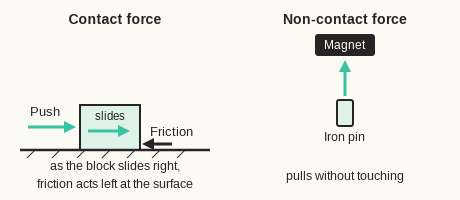
A contact force needs touching surfaces at the interaction being described: a hand pushes a door, a rope pulls a bucket, and a table supports a book. The person need not touch the bucket directly; the rope transmits the pull through contact. Gravity, magnetic forces and electrostatic forces can act without direct contact between the objects. The video's extra names, such as normal force and tension, are not needed to make this distinction.
One object can experience several forces at once. A book resting on a table has Earth's downward gravitational pull and the table's upward contact force. Being at rest does not mean no forces act. Name the object receiving the force, what exerts it and the direction before classifying the interaction.
Try it yourself
A steel paper clip hangs at rest from a thread. A nearby magnet pulls it sideways without touching it. Classify the pull from the thread, the pull from Earth and the pull from the magnet. A student says the thread's pull is non-contact because the person's hand does not touch the clip. What is wrong with that explanation?
Check: The thread's pull is a contact force where thread and clip touch. Earth's gravitational pull and the magnet's pull are non-contact forces. Classify the actual interacting pair, not whether a distant person's hand touches the clip. Several forces can act even while the clip is at rest.
3. Why friction matters
Watch: Slipping, Sliding Science!
SciShow Kids / Complexly
Video not loading? Watch on YouTube (opens in a new tab)
Understand it
Friction acts between touching surfaces and resists their relative sliding or tendency to slide. A book sliding to the right on a stationary table experiences friction to the left. If it slides to the left on that table, friction on the book is to the right. Choose the object and the two surfaces before drawing the arrow. Friction is not always a fixed leftward force, and it can help provide grip as well as slow sliding.
With an adult or teacher, gently slide a closed book across two dry, stable surfaces. A fair comparison needs the same book and a similar starting speed, not a much stronger push on one surface. Compare several trials. Keep the demonstration small: do not run or slide on wet floors or plastic sheets. Roughness is a useful first model, not a rule that every smoother surface always has less friction.
Try it yourself
A block is already sliding left across a stationary tabletop. A hand starts pushing it right, but the block is still sliding left at the moment considered. Which way does the table's friction act on the block? If it later slides right, what changes? Would comparing one gentle push with one hard push fairly isolate the effect of surface type?
Check: While the block slides left relative to the table, friction on it acts right, in this case the same direction as the hand's push. If it later slides right, friction acts left. Friction opposes relative sliding, not automatically the applied push. Different starting pushes or speeds would add another changing factor, so that comparison would not isolate surface type.
4. Mass, weight and floating
Watch: Mass and weight
Sri Chaitanya Academy NEET
Video not loading? Watch on YouTube (opens in a new tab)
Understand it
Mass, measured in kilograms, is different from weight, the gravitational force measured in newtons. Moving an unchanged object to a weaker gravitational field changes its weight, not its mass. An upward force from water does not remove the object's mass or switch off gravity.
Water exerts an upward buoyant force on an immersed object. For a boat floating at rest with no other vertical support, buoyancy equals its downward weight. Even a sinking object can experience buoyancy, but it may be too small to balance the weight. Floating depends on overall density and the water displaced, not weight alone. A hollow boat can displace enough water to support a greater weight than a small stone.
Try it yourself
In a fictional model, a 12 N boat floats at rest with no other vertical support. A 3 N stone has 1 N buoyancy and is released from rest; ignore other forces at that instant. Find each net vertical force. Does the lighter stone have to float? If the unchanged boat moves to weaker gravity, which changes: mass, weight, or both?
Check: The boat has 12 N buoyancy upward balancing 12 N weight downward, so its net vertical force is zero. The stone has 3 - 1 = 2 N net force downward and initially starts sinking, despite weighing less than the boat. It still has a 1 N upward buoyant force; sinking does not mean buoyancy disappears. Moving the unchanged boat to weaker gravity lowers its weight but leaves its mass unchanged. Compare actual forces and displacement, not just which object is called heavy.
Your five-minute revision
Choose a book on a table, a sliding toy and a floating boat. For each, name the interacting objects, draw force arrows, and explain whether the motion changes. Cover your first drawing and repeat it from memory. Fix one missing force or direction at a time.
Try an Evater sample paper and choose force questions that test your explanations.
Explore with a 3D block
Two pushes. One net force.
Change the pushes on opposite sides of the same block. Compare the arrow lengths, then work out the horizontal net force.
Take right as positive: 6 - 4 = 2 N.
2 N to the right.
This net force changes the block's motion. Its direction is not necessarily the direction the block is already moving.
Simplified model: both pushes act on one rigid block along a horizontal line. Friction and turning are ignored; weight and support balance vertically. This is a force diagram, not a prediction of speed or distance.
Try equal pushes, then change just one. Zero net force means no change in motion, not necessarily no motion.
Written by
Evater Team