Try this chapter on paper
Use the original practice PDF after studying. Answers and marking guidance are included. No sign-in needed.
Class 8 Maths sample paper: A Square and A CubePick one topic. Use the video where shown, read the short explanation, then try the question before checking your answer.
1. Square numbers and visual patterns
Watch: Describing numerical relationships with polynomial identities
Khan Academy
Video not loading? Watch on YouTube (opens in a new tab)
Understand it
Draw a 3 by 3 square of tiles. To grow it into a 4 by 4 square, add 4 tiles along one edge and 3 along the other: 7 new tiles. The corner is counted once. For an n by n square, the next border adds (n + 1) + n = 2n + 1 tiles. This explains the difference between consecutive square numbers without calculating both full squares.
For a growth of two tiles along each dimension, add two successive borders. They are not equal: the second border surrounds a larger square. Label the side lengths on your sketch before counting, and count each corner only once.
Try it yourself
A square mosaic grows from 24 by 24 tiles to 26 by 26 tiles. Find the number of extra tiles using two consecutive borders, without first multiplying out both full squares. A learner uses 2 × 49 because the first border has 49 tiles. What has the learner missed?
Check: The first border adds 2 × 24 + 1 = 49 tiles; the second adds 2 × 25 + 1 = 51. The total is 100 extra tiles. Using 49 twice misses the two extra tiles in the second, larger border. Check afterwards that 26² - 24² = 676 - 576 = 100.
Work through an example
A square array grows from 20 by 20 tiles to 21 by 21. Add a row of 21 and a column of 20: 41 new tiles. Counting 21 + 21 counts the new corner twice. The identity (n + 1)² - n² = 2n + 1 explains the border for any whole-number side n, not only this drawing.
Try a different case
A square array gains 57 tiles when its side grows by one tile. Find the original and new side lengths without trying every square. Then find how many tiles are added when that original side grows by two instead of one.
Reasoning: Solve 2n + 1 = 57 to get n = 28, so the sides are 28 and 29. Growing from 28 to 30 adds 57 + 59 = 116 tiles, or 30² - 28² = 116. It is not 2 × 57, because the second border is longer than the first.
2. Square roots and estimating roots
Watch: Approximating square roots
Khan Academy
Video not loading? Watch on YouTube (opens in a new tab)
Understand it
The symbol √ gives the nonnegative square root. For a square's area, this is the side length, not a negative length. To estimate √70, compare 8² = 64 with 9² = 81; squaring 8.3 and 8.4 narrows the bound to 8.3 < √70 < 8.4. In the video's final example, the corrected bound is 11 < √123 < 12, not 144.
Squaring candidate bounds checks which side of a root they lie on. Keep a strict inequality only when the squared values really lie below and above the target. Also separate a root symbol from an equation: √81 = 9, while both 9 and -9 solve x² = 81.
Try it yourself
A square has area 92 cm². Find consecutive integers between which its side length lies, then test whether it lies between 9.5 cm and 9.6 cm by squaring the bounds. Separately, a learner writes √49 = ±7 because both 7² and (-7)² equal 49. Correct the notation.
Check: Because 9² = 81 < 92 < 100 = 10², the side is between 9 cm and 10 cm. More closely, 9.5² = 90.25 < 92 < 92.16 = 9.6², so 9.5 cm < side < 9.6 cm. Write √49 = 7. The equation x² = 49 has the two solutions x = 7 and x = -7; the root symbol names the nonnegative one.
Work through an example
To bound √50, use 7² = 49 and 8² = 64, so 7 < √50 < 8. Since 7.0² = 49 and 7.1² = 50.41, the tighter bound is 7.0 < √50 < 7.1. An estimate is not an exact equality. The symbol √50 denotes the nonnegative square root; solving x² = 50 would also allow its negative opposite.
Try a different case
A learner says √90 = 9.5 exactly because 90 lies between 81 and 100. Check 9.4² and 9.5² to give a tighter bound. Does finding the positive root list every solution of x² = 90?
Reasoning: 9.4² = 88.36 and 9.5² = 90.25, so 9.4 < √90 < 9.5. The proposed 9.5 is not exact because its square is not 90. The equation x² = 90 has two real solutions, √90 and -√90; the radical symbol alone names the nonnegative one.
3. Cubes and cube roots
Watch: Dimensions of a cube from its volume
Khan Academy
Video not loading? Watch on YouTube (opens in a new tab)
Understand it
A cube has three equal dimensions. For 216, factor it as 2³ × 3³, so ∛216 = 2 × 3 = 6. Check by multiplying 6 × 6 × 6. The video works through the related cube with volume 512 cm³. A volume in cm³ gives an edge length in cm, not cm³.
Changing the edge changes all three dimensions: multiplying an edge by 2 multiplies volume by 2 × 2 × 2 = 8. Conversely, eight times the volume means twice the edge for cubes. Do not apply the volume multiplier directly to the edge length.
Try it yourself
A solid cube has volume 729 cm³. Find its edge length and check by multiplication. A second cube has eight times that volume. A learner says its edge is 72 cm because 9 × 8 = 72. Find the correct edge and explain why the multiplier is different.
Check: The first edge is 9 cm because 9 × 9 × 9 = 729. Eight times the volume multiplies each of three equal dimensions by 2, so the second edge is 18 cm. Its volume is 18³ = 5,832 cm³ = 8 × 729 cm³. An edge of 72 cm would multiply the original volume by 8³, not by 8.
Work through an example
A cube with side 4 cm has volume 4 × 4 × 4 = 64 cm³. Doubling the side to 8 cm multiplies all three dimensions by 2, so the volume becomes 512 cm³, eight times as large, not twice. Taking a cube root reverses this volume calculation: ∛512 = 8. Keep cubic units for volume and length units for the side.
Try a different case
A cube has volume 343 cm³. Find its side length. A second cube has eight times that volume. Is its side eight times as long? Calculate its volume and side to check.
Reasoning: 343 = 7 × 7 × 7, so the first side is 7 cm. The second volume is 8 × 343 = 2744 cm³ and its side is 14 cm, since 14³ = 2744. Multiplying volume by eight doubles the side; multiplying the side by eight would multiply volume by 8³ = 512.
4. Recognising perfect squares and cubes
Watch: Simplifying square roots
Khan Academy
Video not loading? Watch on YouTube (opens in a new tab)
Understand it
Prime factors help you recognise perfect powers. A positive integer is a perfect square when every prime-factor exponent is a multiple of 2, and a perfect cube when every exponent is a multiple of 3. For 72 = 2³ × 3², multiplying by 2 completes all pairs, while multiplying by 3 completes all triplets. The results are 144 = 12² and 216 = 6³.
For the smallest positive integer multiplier, add only the missing copies of each prime factor. Check every prime, not only the first one. The video shows pair-grouping for square roots; apply triplets separately for cubes. A number's last digit can rule out some squares but cannot by itself prove that a number is a square.
Try it yourself
Use 200 = 2³ × 5² to find the smallest positive integer that multiplies 200 into (a) a perfect square and (b) a perfect cube. Show the resulting powers. Why is the same multiplier not automatically right for both tasks?
Check: For a square, supply one more factor 2: 200 × 2 = 400 = 20². For a cube, supply one more factor 5: 200 × 5 = 1,000 = 10³. All exponents must be even for the square and multiples of 3 for the cube. Adding just these missing factors gives the smallest multipliers, 2 and 5 respectively.
Work through an example
For 144 = 2⁴ × 3², all prime-factor exponents are even, so it is a perfect square: 12². It is not a perfect cube because the exponents are not all multiples of three. For 216 = 2³ × 3³ the reverse holds: it is 6³ but not a perfect square. Test pairs and triplets separately; one perfect-power label does not imply the other.
Try a different case
Find the smallest positive integer multiplier that makes 72 a perfect square, and separately the smallest that makes it a perfect cube. Check the resulting powers. Must the same multiplier work for both?
Reasoning: 72 = 2³ × 3². For a square, multiply by 2 to obtain 2⁴ × 3² = 144 = 12². For a cube, multiply by 3 to obtain 2³ × 3³ = 216 = 6³. Each multiplier supplies the missing factors for its own grouping rule. The smallest multipliers differ; making a square is not the same task as making a cube.
Your five-minute revision
Choose one idea you can now explain and one you still find tricky. Draw a diagram or work an example from memory. Compare with the lesson and fix the step you missed, then retry it tomorrow.
Try an Evater sample paper and choose questions that match what you have practised.
Explore in 3D
Build a cube, one layer at a time
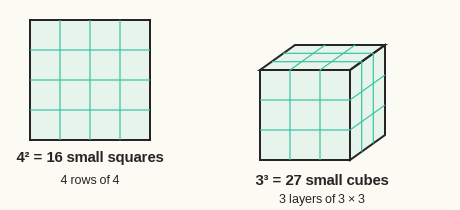
A square counts unit squares. A cube stacks square layers. Change the side length, then reveal the layers to see why volume is n x n x n.
One layer: 3 x 3 = 9 square units.
Shown: 9 x 3 = 27 cubic units.
Full cube: 3 x 3 x 3 = 27 cubic units.
Try this: set the side to 4. Each layer has 16 unit cubes, so four layers make 64. If you show only two layers, you have a rectangular prism with 32 unit cubes, not the full cube.
Written by
Evater Team